
Autorenprofil
The GCF Readiness Programme is a crucial tool for turning the promises of the Paris Agreement into real-world action.
The dust has barely settled on COP30 in Belém, where negotiators, scientists, policy-makers and civil society gathered from across the globe. The summit was widely framed as the “implementation COP”, a moment to shift from promises to concrete action on climate, finance, adaptation and justice.
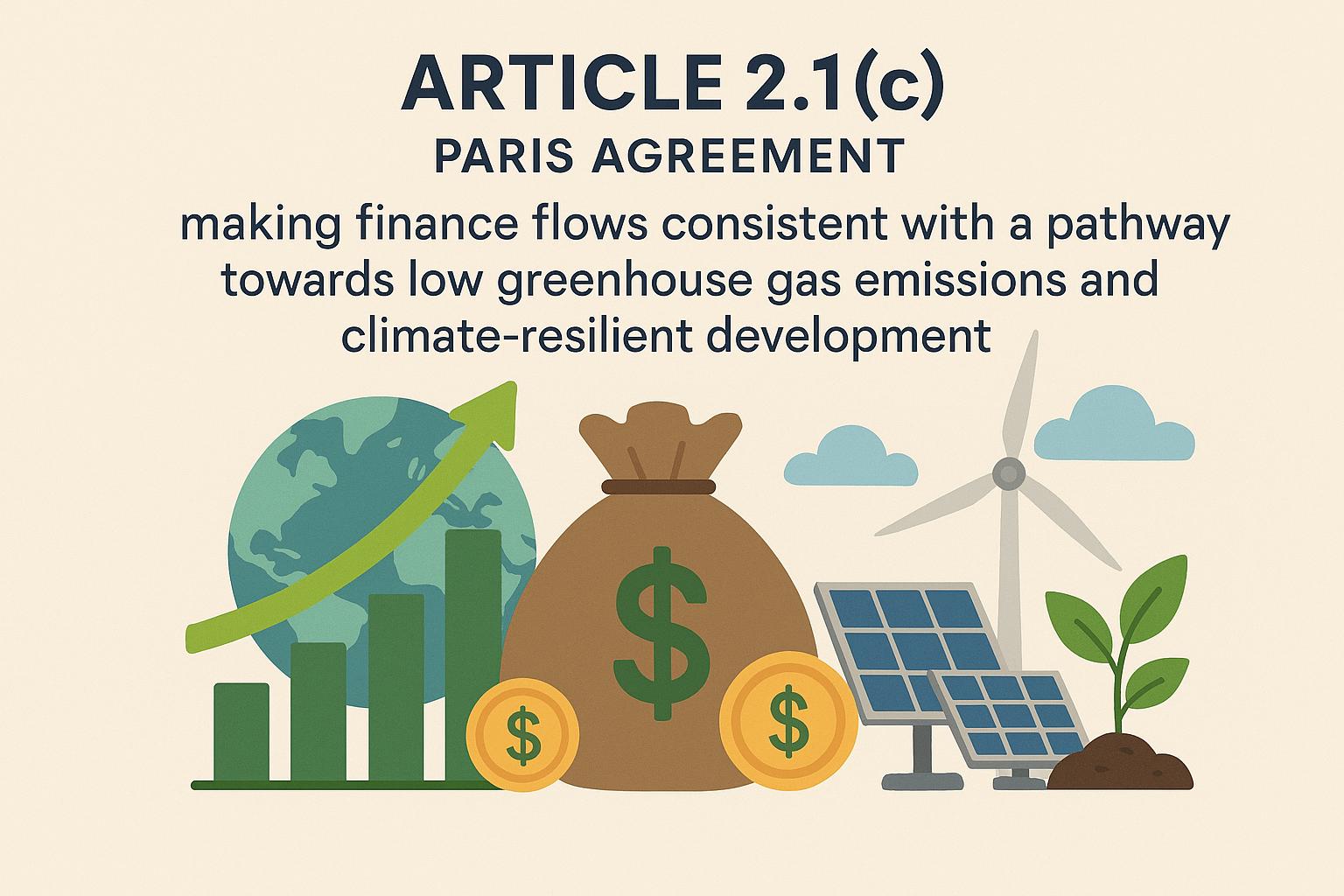
That spirit of pushing from ambition to real-world change makes the timing perfect to reflect on what aligning finance flows with climate goals might actually look like. The Paris Agreement contains a deceptively simple clause: Article 2.1(c) calls on public and private finance flows to support low greenhouse gas emissions and climate-resilient development. This means steering investments away from carbon-heavy projects and toward those that support sustainable, climate-smart outcomes. But nearly a decade after the Agreement was signed, the global community still lacks a shared definition of what “consistent finance flows” really look like in practice.
Our research paper aims to help fill that gap by digging into what actually happens on the ground. It focuses on the work of the Green Climate Fund (GFC) and its main capacity building instrument, the GCF Readiness Programme. We wanted to see how countries are using Readiness support to implement Article 2.1(c) in the real world.
Our analysis covered 53 Readiness Proposals submitted between 2017 and 2024 by 44 countries in Africa, Asia Pacific, Latin America and Eastern Europe. We manually coded a total of 1083 individual activities using the Whitley framework that groups government tools into four types: financial policies and regulations, fiscal policy tools, public finance instruments, and information instruments.
This method lets us treat each proposal as a bundle of potential levers. It shows which tools countries actually propose when they say they aim to align finance flows with climate objectives.
Only about 25 % of all listed activities were clearly aligned with the goal of Article 2.1(c). The rest reflect broader capacity building and planning tasks.
Among the Article 2.1(c) relevant activities, those that fall under information instruments stand out. These include stakeholder workshops, studies, awareness campaigns, guidance documents and consultations. Together they account for about 15 % of all activities in our sample.
For many lower-income countries, this makes sense. Before one can draft regulations or fiscal incentives that steer finance, one needs a foundation of shared understanding and institutional capacity.
Financial policies and regulations come next at nearly 6%. These cover efforts such as designing sustainable finance taxonomies, revising supervisory frameworks, and drafting national climate investment plans. This kind of work is more common in upper-middle-income countries and in regions such as Latin America and the Caribbean, where regulators appear more open to green finance frameworks.
By contrast, fiscal policy tools and public finance instruments combined make up just over 4%. Their limited use likely reflects political constraints or tight budgets. Reforming taxes or subsidies can be politically delicate. And providing public guarantees or equity often requires fiscal room that many developing countries do not have. Yet those instruments matter most if the aim is to mobilise private capital at scale. Their absence suggests we are still only at the start of the journey.
We also observe clear regional differences. Latin America and the Caribbean account for the largest volume of Article 2.1(c) linked activity, followed by the Asia Pacific. Africa and Eastern Europe lag in both activity volume and in the sophistication of proposed tools. Across all regions, information-based instruments remain the backbone of readiness efforts. GCF Direct Access Entities seem to lean heavily on Information instruments, while International Access Entities employ a broader mix of tools.
In the aftermath of COP30, the world has recommitted at least in discourse to the idea that promises must turn into reality. The Readiness Programme emerges in our research as a modest but meaningful architect of future climate-aligned finance. It is not transforming financial systems overnight. Instead, it is helping countries draw early blueprints, train stakeholders, build awareness and begin shaping the rulebooks for climate finance.
If aligning finance flows under Article 2.1(c) is the goal, the challenge ahead is to shift from building knowledge to implementing change.
Our study recommends a tiered readiness approach that reflects each country’s maturity in climate finance and institutional capacity. We also call for stronger monitoring tools to track whether initial readiness activity leads to real changes in financial flows over time.
As global climate diplomacy moves forward and Article 2.1(c) gains increasing relevance, the kind of evidence provided in this research will be essential. The path may be slow, but the direction is becoming clearer.
“The economy is a wholly owned subsidiary of the environment, not the reverse.” — Herman E. Daly
Paper: Kinywamaghana, Alexandra B., Manhal Hassan, and María José Valverde. 2025. The GCF Readiness Programme as a Support Mechanism to Implement Art. 2.1(c) of the Paris Agreement: GCF Contribution to Making Finance Flows Consistent with Low Carbon and Climate Resilient Development Pathways.
Frankfurt School gGmbH
Adickesallee 32-34
60322 Frankfurt am Main