To Author's Page
Most modern economic models assume that people act in pure self-interest, the so-called “homo oeconomicus.” And for many situations, that assumption works well enough.
But there are good reasons to believe that humans are wired differently. Altruism and reciprocal trust have helped communities thrive for centuries. The question I wanted to explore in my Bachelor thesis for my Bachelor in Business Administration (BSc) at Frankfurt School was: how much of that is still visible… when you strip away all context and just observe students making anonymous decisions with strangers?
Using over 20,000 individual decisions collected via the online platform ClassEx from universities across the globe, I tested how robust these “pro-social” tendencies really are. Three classical experiments formed the basis: the Dictator Game (one player decides how much to give to a passive recipient), the Ultimatum Game (a proposer makes a take-it-or-leave-it offer that the responder can reject, leaving both with nothing), and the Trust Game (a trustor sends money that gets multiplied, hoping the trustee returns a fair share).
Here’s what the data showed – in six observations.
In the Dictator Game, where keeping everything is the individually rational choice, students in our dataset gave away roughly 30% of their endowment on average. This is well in line with what decades of experimental research have found across different populations.
In the Ultimatum Game, offers below 30–40% of the endowment were mostly rejected. Responders in our sample chose to walk away with nothing rather than accept what they perceived as an unfair split. At least among students, the willingness to enforce fairness norms, even at personal cost, appears deeply embedded.
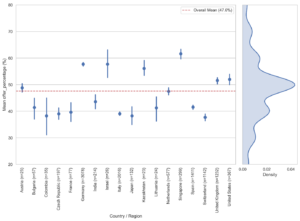
Generosity varied significantly across countries. In the Ultimatum Game, German students proposed around 60% of their endowment on average, while Italian students offered closer to 40%. Southern European countries tended toward lower offers, US subjects scored above the global mean. Even within a relatively homogeneous group like university students, cultural background seems to matter a lot.
In the Trust Game, trustors who sent more to a stranger received more back on average. The mean return ratio in our dataset exceeded 100% meaning that, at least in this sample, extending trust to an anonymous counterpart was on average a net positive. Trustees tended to reciprocate the vulnerability, even in a one-shot setting with no consequences for keeping everything.
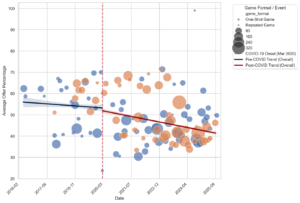
A growing body of research has suggested that shared trauma — like the COVID-19 pandemic — boosts solidarity and generosity. In our data, the picture looked different. Ultimatum Game offers actually decreased in the post-pandemic period. Whatever initial surge in cooperation the crisis may have triggered, it did not seem to persist in the long run, at least not in the student populations captured here.
One of the more practical findings: decision time was negatively correlated with offer size in the more complex games. Students who deliberated longer tended to send less. The interpretation? The first moral impulse seems to lean toward generosity. It’s the strategic recalculation that pulls offers down. So if you’re ever negotiating and want the other side to be generous — maybe don’t give them too much time to think it over.
It is important to note that these findings are a starting point, not a final answer. This analysis is based on classroom experiments heavily skewed toward European economics students, and the low explanatory power of the regression models suggests that much of human behaviour comes down to highly individual differences that a single dataset cannot fully capture.
But that might be the most encouraging takeaway. Despite all the noise, and even in settings designed to strip away reputation and social pressure, pro-social behaviour consistently breaks through the math. The data shows us that not all hope is gone. We are not just rational calculators; fairness and reciprocal trust are hardwired into our veins. Recognizing that this cooperative instinct still exists—even among students—is the first step to ensuring we don’t design systems that accidentally optimize it away.
If you’re curious about the full analysis or want to discuss any of the findings, I’d be happy to connect.
Frankfurt School gGmbH
Adickesallee 32-34
60322 Frankfurt am Main