
To Author's Page
Artificial Intelligence is transforming our world faster than ever, not only impacting how we work, but also the way we live. As one of the key drivers of digitalization and automation, AI shapes industries and societies worldwide. Yet, its effects on sustainability topics are often overlooked in the mainstream debate. At Frankfurt School, we – the FS Sustainability Initiative – are therefore investigating how AI influences the Environmental, Social, and Governance (ESG) dimensions of sustainability. In a three-part blog series, we will examine both the opportunities and risks of AI systems for sustainability. This first part focuses on the environmental dimension by asking the key question:
Does the growing use of AI have a net positive or negative impact on the environment?
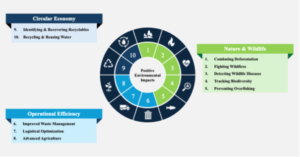
In general, the rise of artificial intelligence provides access to many technological advances that benefit environmental sustainability issues. In particular, the data collection and analysis capabilities of AI systems have great potential to combat the effects of climate change. In this context, DataNorth lists a number of positive environmental impacts that contribute to the preservation of nature and wildlife:
In addition to their direct contributions to nature and wildlife conservation, certain AI models also increase the operational efficiency of businesses, helping to reduce their negative impact on the environment.
For example, a WWF pilot project tested an AI-powered purchasing system for grocery stores, which resulted in an average reduction in food waste of 14.8%. If implemented across the entire grocery sector, around 907,000 tonnes of food waste could be avoided, which corresponds to approximately 13.3 million tonnes of CO2-equivalent emissions and financial benefits of 2 billion USD.
Another area that can be improved by AI systems is corporate logistics. By evaluating route and traffic data, general transport can be optimised, congestion avoided and emissions reduced. Additionally, the supply chain resilience of companies can be examined through an automatized simulation of potential disruptions or shortages, finding improvements to address potential risks.
Furthermore, the agricultural sector is also being enhanced through the use of AI models to analyse weather, soil and crop data in order to increase crop yields, reduce resource consumption and minimise environmental damage.
The circular economy similarly benefits from AI systems, which can help for example in the identification and recovery of recyclable materials. AMP Robotics and Machine X have developed AI tools that can collect recyclable materials twice as fast and more consistently than humans. According to AMP Robotics, their 300 tools in use have already helped to avoid around 1.8 million tonnes of greenhouse gas emissions.
Adding up on this, water management is another important issue that AI systems are helping to solve. By monitoring water quality, pollution can be detected within a very short time, which improves the overall treatment and reuse of water.
Figure 1 provides a summary overview of the positive effects of AI on the environment.
Figure 1: Overview of Positive Environmental Impacts of AI
Source: Own Creation based on DataNorth
However, these advantages also come at a high price for the environment. AI systems are among the most emission-intensive technologies, with training an AI model alone generating as many emissions as 62.6 petrol-powered cars in a single year. Further, these estimations are based on older AI models that required less training, with the current trend rising upwards.
Another problem is the high resource consumption of the data centres’ servers that AI systems need for their calculations. Especially, computationally intensive AI applications such as image generators consume more and more energy and water to power and cool the servers. According to an article by MIT from 2023, Open AI’s DALL-E 3 requires as much energy to generate a single image as to fully charge a mobile phone.
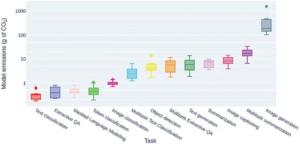
In this context, Figure 2 shows the results of a study by the Institut Polytechnique de Paris from 2024 on the different AI model emissions for specific tasks. The Figure makes clear that on average the amount of created emissions depends on the difficulty and the required calculation capacity of the task, with the image generation leading by far to the most emissions.
Figure 2: AI Model Emissions per Task
Source: Institut Polytechnique de Paris
In general, the most important challenge Artificial Intelligence faces is the exponentially increasing resource consumption that comes along with the continuing AI trend.
Current scientific projections show that while data centres already consume 2% of the total energy use of the US, their energy consumption is expected to double within the next two years.
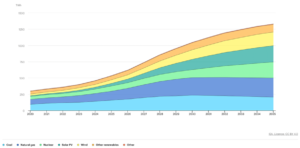
The major problem of this trend is the vast share of non-renewable energy that is used to power the data centres. According to the International Energy Agency (IEA), the global renewable energy generation for data centres (excluding nuclear) only accounted for less than 30% in the last four years and, following the base case, is not expected to exceed 50% until 2035.
Main contributors to these circumstances are the coal-intensive Chinese data centres (≈ 70%) and the heavy gas dependency of the US (≈ 40%), that together represent a large share of the global electricity consumption of data centres worldwide.
Figure 3: Sources of Global Electricity Generation for Data Centres (2020-2035)
Source: IEA
In summary, we can say that AI offers important opportunities for the transition to a greener and more environmentally friendly world, but at the same time also has an increasing resource consumption, which must be addressed in order to achieve responsible implementation. Solutions to this consumption problem could include expanding renewable energies to power data centres and reducing unnecessary training and computing processes in AI applications to make them more efficient. Therefore, the question of whether AI has an overall positive or negative impact on the environment cannot be answered definitively here and should rather be rephrased as:
How can we increase the responsible use of Artificial Intelligence to maximise positive environmental impacts?
Frankfurt School gGmbH
Adickesallee 32-34
60322 Frankfurt am Main